Welcome to Big Bear Zoo!
The Big Bear Alpine Zoo is passionately committed to the principals of rehabilitation, conservation, and animal welfare. Through our actions, we inspire visitors to embrace responsible stewardship of our local ecosystems while increasing awareness about the fascinating wildlife that calls our region home.
The Big Bear Alpine Zoo is a rehabilitation facility offering injured, orphaned and imprinted wild animals a 2nd chance. We are extremely proud that the vast majority of animals brought to us for rehabilitation are successfully released back into their native environment. Those that remain with us on exhibit are either too injured or have been imprinted by humans and cannot be released back into the wild to care for themselves.
The Big Bear Alpine Zoo (formally Moonridge Animal Park) opened its doors in 1959 after a devastating wildfire roared through the San Bernardino National Forest displacing local wildlife. The zoo is currently home to mammals, birds, and reptiles representing over 85 species and is located in San Bernardino County, the largest County in the contiguous United States.
Our Timeline
1959
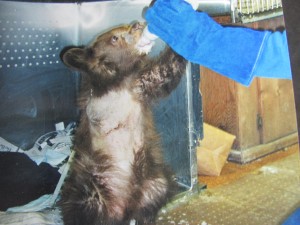
A forest fire engulfs the San Bernardino National Forest. In the aftermath, several injured animals were found that required care. A makeshift hospital/rehabilitation area called the Wildlife Habitat was set up on land where the zoo currently resides. Loris Cady, developer of Moonridge Mountain Estates, Inc., built the first two cages. The new facility was overseen by the workers at the local ski area. At the time, the area was open forest which allowed the animals to heal in their natural environment. An orphaned 30 pound baby black bear and two bobcats were the first residents of the future Zoo.
1960
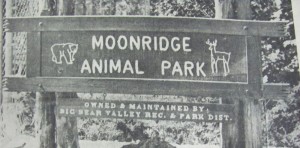
Moonridge Mountain Estates, Inc., agreed to a 50 year sub-lease between Big Bear Valley Recreation & Park District and Moonridge Golf & Mountain Club, Inc. who was in a 99 year lease with Moonridge Mountain Estates.
1960
Moonridge Mountain Estates, Inc. sends a letter to the Park District offering to keep up the “animal deal” in the Moonridge District during its early stages. They offered to cooperate in every way to keep expenses down to a minimum and were willing to feed and take care of the animals. They only expected the Park Board to reimburse the cost of food. Water would be supplied by the water company for $3.50 per month (when available). The letter suggested some sort of insurance be looked into when the park was opened.
1960
The Park District Board allocates $5,000 for the development of the new zoo but decided to hold off until a maintenance cooperative agreement is reached with Moonridge Mountain Estates.
1961
A request was sent to Department of Fish and Game requesting animals and game for the zoo. Fish and Game advised that there was a nuisance bear in the San Gabriel Mountains which they would trap and send; a bear cub was acquired.
1961
A black bear was lassoed out of a tree during the forest fire at Barton Flats and was named Herman; Herman was to became of the most famous residents.
1962
Three silver foxes were donated to the zoo by Mr. Tom Marks. A plaque in Mr. Marks’ honor was placed on the pen.
1963
The creek channel was graded and the dam and pond were completed.
1965
Horseback riders rescue a baby fawn that was attacked by a coyote on Skyline Drive and it was brought to the zoo.
1966
The district hires Mr. Harold Darling as zoo supervisor/care taker. Mr. Darling was the sole caretaker of the zoo and the animals for several years.
1966
Jiggers the black bear was caught in a YMCA Camp after ravaging the dumpsters on a daily basis. She was named by the campers who were heard to say, “Jiggers, here comes the bear!”
1966
The zoo received permission from the Department of Fish and Game to keep golden eagles at the zoo.
1970
District lends Me-hee the mule deer to the Slauss Movie Co. and receives 16 year old “Sheba” the mountain lion as a thank you. Me-hee can be seen jumping on the opening scene of Walt Disney’s “Wonderful World of Color.”
1973
George Birdsell, Park Board Member, local animal tracker and Department of Fish and Game representative supplies the zoo with captured coyotes and bobcats.
1975
Zoo property was offered to the Park District Board for $15,000 per acre. The board determined that there was 35 years left on the lease at $1.00 per year and declined the offer.
1977
Five mountain lions were born at the zoo and were taken at a very early age to Cougar Hill Ranch training center for the movie industry. During their first week, they starred with Farrah Fawcett in a car commercial.
1979
United States Department of Agriculture requires a signed agreement with a consulting veterinarian to inspect the facility and instill a program of disease control and prevention. Dr. Harold Stephens is the first Veterinarian of Record for the Zoo.
1980
District receives proposal from Mr. George Toth, owner of Cougar Hills Ranch in Littlerock, to lease the property. Mr. Toth proposed to replace all existing animals with retired movie animals and retain all rights to the zoo. Animal shows would be done 3 days a week and a petting zoo installed. The District rejects the proposal.
1981
During baby season at the zoo, two baby great horned owls were brought in, a bobcat had a litter of kittens, and a wolf gave birth to two pups. Both the bobcat and wolf litters were given to George Toth for use in the movie industry.
1982
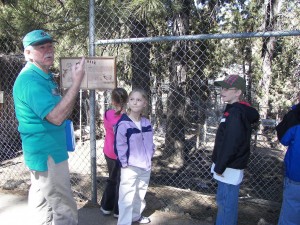
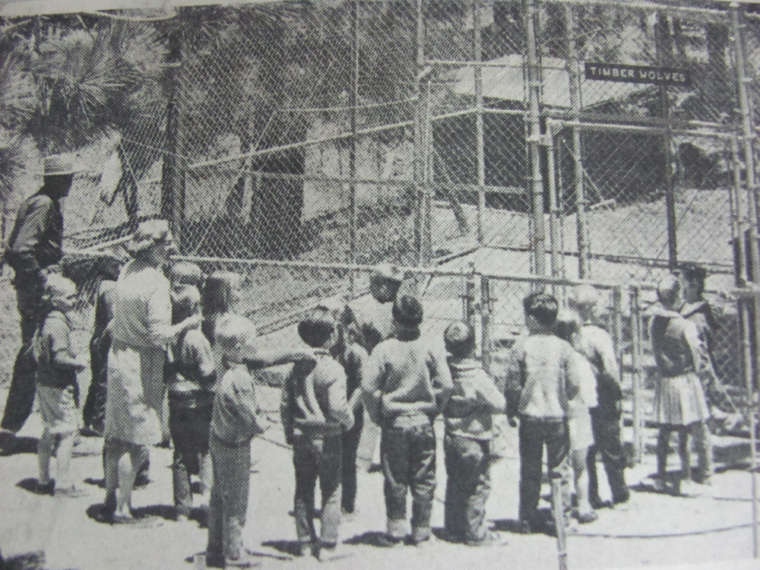
Zoo tours, which have always been very popular with Big Bear school kids, are requested from schools throughout San Bernardino County.
1982
District receives a call from the Wildlife Way Station in Los Angeles asking if we need any animals. A bear is requested and Tacoma the black bear joins the family.
1982
Jiggers the bear, who was suffering from poor heath, was taken to LA Zoo for x-rays. It was determined that nothing could be done surgically and Jiggers was brought home and put to sleep on October 21st.
1985
A female wolf, Nakita, was stolen from her enclosure by two men who had offered the Zoo Director $400 for her earlier in the day. When he refused they commented that they would get one, one way or the other. While the Director was occupied cleaning out the bear enclosure, the men from Newport Beach jumped the fence, cut the chain link with a large tool and pulled her out of the enclosure and left the zoo. She was found four months later when one of the men was fired from his job and the supervisor called the authorities and reported that the man said he had stolen the wolf from the Big Bear Zoo. The man was convicted of grand theft and spent time in jail for the crime. Nakita was returned unharmed.
1986
The first bald eagle, Stumpy, who lost his leg in a wolf trap, arrived at the zoo courtesy of Alaska Airlines. The eagle, scheduled to be euthanized, was saved by a Big Bear resident who worked for the Wrangle Ranger District in Alaska.
1989
The Friends of the Moonridge Zoo was established in 1989 as a nonprofit 501(c)3 organization. The Friends of the Moonridge Zoo’s mission is to support the Moonridge Zoo by inspiring understanding, respect and environmentally responsible action for the conservation of wildlife and wildlife habitat through public education, volunteer support, fundraising and development, and key project financial support.
1992
A new Zoo Task Force is established between the County of San Bernardino, the City of Big Bear Lake, the Forest Service, and Bear Mountain to deal with the future of the zoo and to “create a vision for the best animal facility for Big Bear Valley.”
1994
A Memorandum of Understanding is entered into between the Moonridge Zoo and the California Department of Fish and Game for rehabilitation of native sick, injured or orphaned birds and mammals.
1996
An intensive six-week “Grizzlies Come Home” Campaign successfully rallies cash donations from across the county and generous material and labor donations from local contractors, to save a mother grizzly and her two cubs who were scheduled to be euthanized. The trio was successfully transported to their new home. Zoo keepers name the mother grizzly “TuTu,” the female baby grizzly “Ayla,” and a generous donation from the local Harley Association names baby boy grizzly ”Harley.”
2000
The District Board reviews the plot plan of the new zoo for the first time. The zoo will be set up in a chronological timeline that coincides with the history of Big Bear.
2001
Memorandum of Understanding is entered into between Big Bear Valley Recreation and Park District, the Friends of the Moonridge Zoo, San Bernardino National Forest Association, and San Bernardino National Forest Pacific Southwest Region USDA Forest Service to establish a framework of cooperation and for the exploration of opportunities to relocate the Moonridge Animal Park from its current location to a site on National Forest System lands in the Big Bear Valley area.
2002
The County Board of Supervisors obligates $25,000 from the priority policy needs budget to the Park District to develop a business plan related to the relocation and operation of the Moonridge Animal Park
2006
Canadian Lynx Aslan comes from CALM in Bakersfield. She was not doing well because of the heat and everyone involved in her transfer believed that the cool, mountain environment would suit her better.
2008
The County Board of Supervisors transfers $5,750,000 from the County General Fund into the Moonridge Zoo Relocation Project for the design, construction and relocation of the zoo.
2008
Debra Richardson Becomes curator of the Zoo.
2008
A letter was sent to the Forest Service stating that there is no evidence to support the claim that there are “no other suitable sites” available in the region and appears to be insufficient and compelling to justify a special use permit on public forest land. This is found to be true and the Discovery Center zoo location is abandoned.
2010
The County enters into a lease agreement with the current owners of the zoo property for three (3) years with three (3) two-year options.
2012
The zoo rescues black bear “Pooh” who was a nuisance bear and was scheduled to be euthanized for eating $8,000 worth of a grower’s honey.
2014
March 25, the San Bernardino County Board of Supervisors approved the adoption of the Mitigated Negative Declaration 5/0, as part of the process for the relocation of the Big Bear Zoo. This was the final step required in the environmental review of the proposed relocation which allows the Special Districts Department to proceed with development of the relocation site.
2014
The zoo receives Snow Leopard sisters Asha and Shanti from the Woodland Park Zoo in Seattle Washington. The sisters were born into the Species Survival Program with a birth defect that causes both of the right eyes to be removed. Because of the birth defect, they have been removed from the SSP and will live their lives with us at the zoo.
2015
Curator Debbie Richardson retires and Bob Cisneros is hired as the new Curator.
2016
Tuesday, May 24 – The San Bernardino County Board of Supervisors votes unanimously to approve the funding and awards the contract for the construction of the new zoo to M.S. Construction Management Group from Dana Point. On Friday, May 27, we officially Break Ground!
2016
July 25 – Construction of the new Zoo begins.
2018
With the help of contributing veterinarians and outside subject matter experts, the zoo performs wellness exams on all of the zoo’s black bears and grizzlies.
2019
National Geographic photographer, Joel Sartore, comes to Big Bear Alpine Zoo and photographs seven species at the zoo to add to his Photo Ark. The species added to the Photo Ark were: Acorn woodpecker, American crow, Bush bunny, Common raven, Humboldt’s flying squirrel, San Joaquin kit fox, Steller’s jay.
2020
March – Bob Cisneros vacates the Curator position and a search begins for the new curator
2020
August – The new facility is completed and staff begin preparing the site and enclosures for the arrival of the new residents
2020
September 20 – After 61 years of operation and saving wildlife, the original Zoo site closes its doors to the public
2020
September 25 – Grizzly Bear, Harley, becomes the first resident of the new zoo. Brian Loudis, Big Bear Alpine Zoo Veterinarian of Record and an amazing team of Veterinarians, Vet Techs, Keeper staff, Fish and Game and San Bernardino County Sheriff work tirelessly over the weekend and move the Grizzly Bears, Black Bears, Snow Leopards, Wolf Pack, Coyotes and the Deer. The care the animals received was phenomenal and caring. Each animal received a health check and necessary care before, during and after the move. All were successfully moved and introduced into their new homes over the next week
2020
October – Bill Hoffman becomes the new Curator.